Beyond Messaging: Synchronizing Presence Across Microsoft Teams and Google Chat

 August 22, 2026
 August 22, 2026


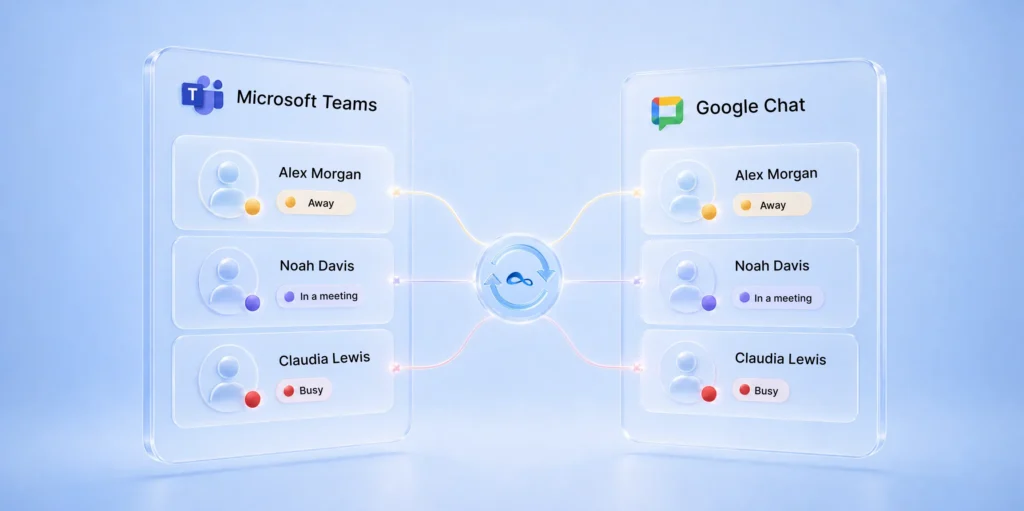
Table of contents
- 1. Why messaging interoperability isn’t enough
- 2. What is presence? More than a green dot
- 3. Why presence matters
- 4. The interoperability challenge
- 5. How cross-platform presence changes collaboration
- 6. How cross-platform presence synchronization works
- 7. Real-world use cases
- 7.1. 1. Mergers and acquisitions
- 7.2. 2. Mixed-platform enterprises
- 7.3. 3. Partners, contractors, and suppliers
- 7.4. 4. Time-sensitive operations and support
- 8. Key considerations for implementing cross-platform presence synchronization
- 9. Presence synchronization with NextPlane OpenHub
- 10. Presence makes cross-platform collaboration complete
Organizations today rarely rely on a single collaboration platform. Microsoft Teams and Google Chat increasingly coexist within the same enterprise, across business units and organizational boundaries.
In fact, nearly half of organizations use both Microsoft and Google productivity platforms. According to Okta’s Businesses at Work report, 48% of companies use both ecosystems — a clear sign that multi-platform collaboration is now a common enterprise reality.
There are several reasons enterprises end up operating both platforms.
Mergers and acquisitions frequently bring together organizations with different technology stacks. Rather than standardizing on a single collaboration platform immediately, many organizations continue operating in both environments for months — or even years — after a deal closes.
Other organizations let regional teams choose the tools that best fit their workflows, collaborate with partners and contractors on different platforms, or intentionally maintain multiple ecosystems to preserve flexibility and reduce vendor lock-in.
Supporting multiple platforms offers clear collaboration benefits. Teams can use the best tool for the task at hand, meet customers and partners on platforms they already use, and stay flexible as business needs evolve.
While supporting multiple platforms has significant advantages, it also comes with an often-overlooked challenge: fragmented collaboration.
NextPlane OpenHub addresses that fragmentation by connecting Microsoft Teams and Google Chat so employees can collaborate across platforms without leaving their preferred application. Now, OpenHub is extending that interoperability beyond messaging with cross-platform presence synchronization.
Messaging alone doesn’t solve the entire collaboration problem. Imagine a Microsoft Teams user trying to reach a colleague who primarily uses Google Chat. Without presence synchronization, they may not know whether that person is available or unavailable. The result can be duplicate outreach, unnecessary interruptions, or the mistaken assumption that a delayed response means the message is being ignored.
Across a large organization, those small moments of uncertainty add up. Employees switch between applications to check availability, follow up unnecessarily, and lose time deciding when to reach out.
The solution goes beyond just enabling messages to flow between platforms — it enables context to flow as well.
With NextPlane OpenHub presence synchronization, Microsoft Teams and Google Chat users can see each other’s availability in near-real time. Instead of guessing, employees get useful context for deciding when to reach out — while continuing to work in their native collaboration app.
Here’s why shared presence is the missing context layer in cross-platform collaboration — and how OpenHub brings it to Teams and Google Chat.
Why messaging interoperability isn’t enough
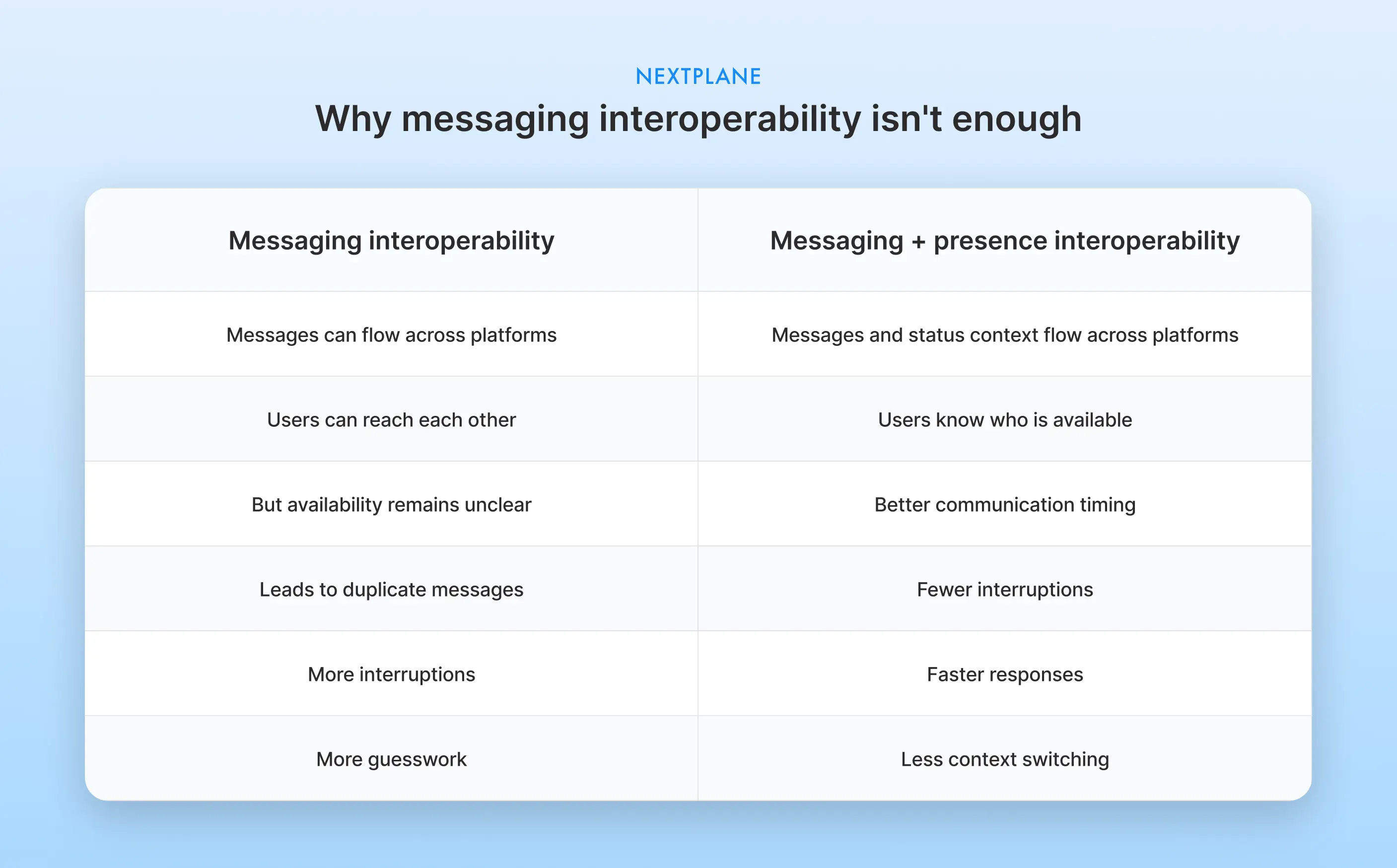
Messaging interoperability lets employees communicate across Teams and Google Chat. On its own, it doesn’t provide context about whether the person on the other side is available.
Before reaching out, people naturally want to know whether a colleague is available. Without that visibility across platforms, employees are forced to guess — leading to unnecessary interruptions, duplicate messages, delayed responses, and more context switching.
This is the gap presence fills.
Presence adds the contextual layer messaging alone can’t provide. It helps employees decide whether to reach out now, wait until a colleague is available, or contact someone else.
Synchronizing presence across Teams and Google Chat brings that context across the platform boundary instead of leaving employees to guess.
What is presence? More than a green dot
When people think of presence, they often picture the familiar green dot next to a colleague’s name that lets us know they’re available to chat.
In reality, presence is much more than a simple online or offline indicator.
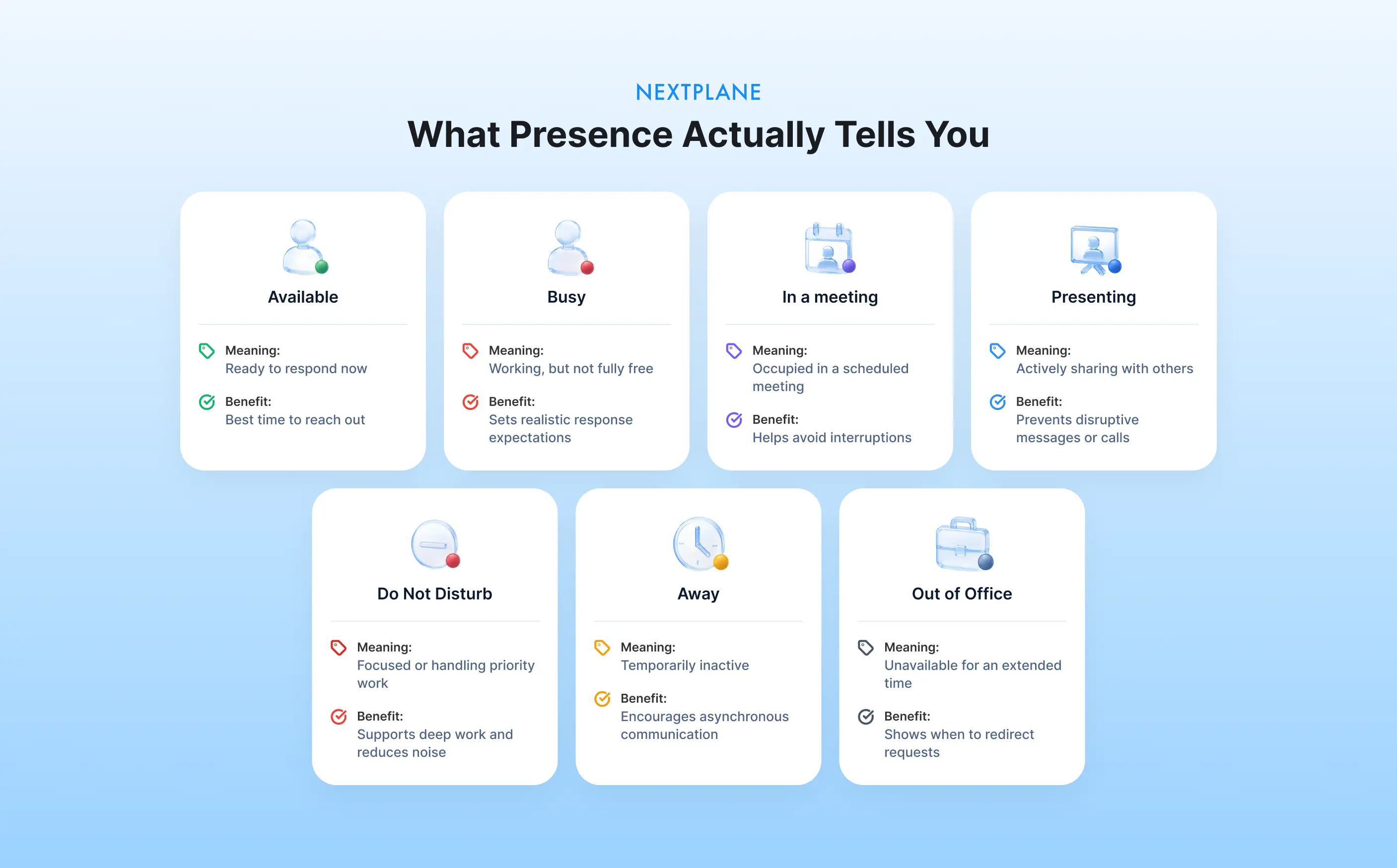
Presence communicates a person’s current availability and work status, helping colleagues understand the best time and way to reach them. Depending on the collaboration platform, presence may include states such as Available, Busy, Away, Do Not Disturb, and Offline.
Modern presence is also dynamic. Google Chat and Microsoft Teams can reflect changes in availability based on platform signals such as activity, meetings, calendar events, and user-selected status. As an employee moves through the workday, presence gives colleagues a more current view of availability and reachability.
That context matters in day-to-day collaboration. When employees can see that a colleague is unavailable, they can choose to wait or contact someone else rather than interrupting unnecessarily.
Presence turns availability into useful context: should I reach out now, wait, or contact someone else? Across Teams and Google Chat, that simple context can make communication more efficient and less disruptive.
Why presence matters
Presence helps employees collaborate more efficiently by reducing the uncertainty around a colleague’s availability.
Employees can avoid unnecessary interruptions, set more realistic expectations for response times, and make better decisions about when to follow up or escalate.
In short, presence provides context behind availability.
That means fewer distractions and more confident communication.
Employees can prioritize urgent conversations, embrace asynchronous communication when an immediate response isn’t required, and spend less time checking multiple applications or repeatedly following up.
For organizations that rely on both Microsoft Teams and Google Chat, interoperable presence extends those benefits across platforms so users can make communication decisions without leaving the tool where they work.
The interoperability challenge
The core interoperability challenge is simple: presence information typically remains confined to the platform where it originates.
A Microsoft Teams user can see the availability of colleagues on Teams, while a Google Chat user can see the status of coworkers in Google Chat.
At the platform boundary, that visibility stops.
Without interoperable presence, a Teams user cannot easily see a Google Chat colleague’s current availability from Teams, and the same limitation exists in the opposite direction.
That gap pushes employees back toward application switching, duplicate outreach, and unnecessary follow-ups — the very friction interoperability is meant to remove.
Messaging interoperability connects the conversation. Presence interoperability adds the context needed to make that conversation more effective.
How cross-platform presence changes collaboration
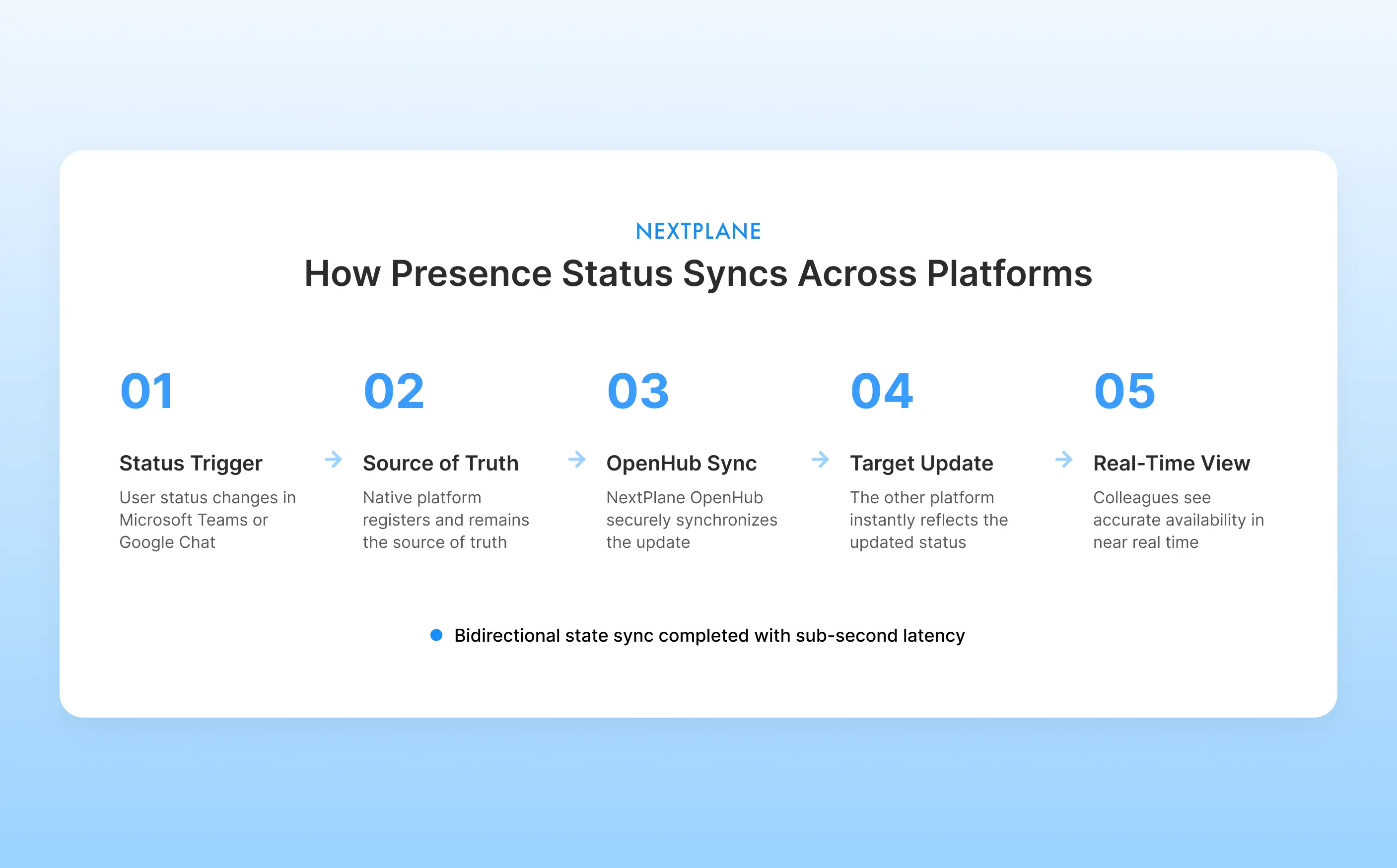
Cross-platform presence interoperability extends availability visibility across Teams and Google Chat. Instead of seeing presence only for users on the same platform, employees can view a colleague’s synchronized availability at a glance.
This shared visibility allows employees to make better communication decisions without leaving their preferred platform. A Microsoft Teams user can immediately see whether a Google Chat colleague is available before sending a message or launching a call. A Google user has the same visibility into the status of colleagues on Teams.
The result is a more connected collaboration experience: less application switching, fewer unnecessary interruptions, and better-informed communication decisions.
Teams also gain more realistic expectations around response times, reducing unnecessary follow-ups and premature escalations.
These benefits also extend beyond internal collaboration. Organizations can work more effectively with contractors, suppliers, customers, and business partners who use different collaboration platforms, making cross-company communication feel as seamless as if everyone were using the same tools.
How cross-platform presence synchronization works
Cross-platform presence synchronization extends Google Chat and Microsoft Teams interoperability so availability updates can be shared automatically between the two platforms. As employee availability changes, OpenHub synchronizes presence in near-real time so colleagues can see current status from the platform where they already work.
Employees continue working in their preferred platform without changing their workflows. There’s no separate client, bot, or management portal to learn. OpenHub makes presence interoperability part of the native Teams and Google Chat experience rather than introducing another collaboration layer for users to manage.
For IT teams, administration remains straightforward. Presence interoperability is managed through the existing NextPlane OpenHub deployment and native Microsoft and Google admin controls. Organizations retain ownership of their identities, while Microsoft and Google remain the authoritative sources for identity and presence information.
The result is a native experience for users without adding another administrative layer for IT.
Real-world use cases
Distributed work makes digital availability cues more important, especially when colleagues do not share the same office — or the same collaboration platform.
When coworkers cannot rely on the visual cues of a shared workplace, synchronized presence provides an important signal for deciding when to communicate.
1. Mergers and acquisitions
After a merger or acquisition, organizations often continue operating multiple collaboration platforms while IT teams work through long-term integration plans.
By allowing employees in both organizations to see each other’s availability, presence synchronization helps maintain collaboration without forcing an immediate migration to a single platform.
2. Mixed-platform enterprises
Some enterprises intentionally operate both Microsoft Teams and Google Chat across business units, regions, or subsidiaries.
Synchronized presence helps those teams collaborate across platform boundaries without requiring an immediate standardization on one suite.
3. Partners, contractors, and suppliers
External teams frequently become an extension of internal operations.
Sharing presence information across platforms helps improve coordination, reduces communication bottlenecks, and enables faster decision-making without requiring everyone to adopt the same tool.
4. Time-sensitive operations and support
In operational, customer support, and incident response environments, every minute matters. Before escalating an issue or initiating a call, employees can quickly identify who’s actually available, reducing unnecessary interruptions and ensuring requests are directed to the right person more efficiently.
Key considerations for implementing cross-platform presence synchronization
Not every interoperability solution delivers the same experience.
When evaluating cross-platform presence synchronization across Microsoft Teams and Google Chat, it’s important to look for a solution that feels native to users while being simple for IT to manage.
As you begin searching for a solution to connect Google Workspace and Microsoft Teams, here are some key features to keep in mind.
Native user experience
Employees should be able to continue to work in Microsoft Teams or Google Chat without changing their daily workflows or learning a separate application. Presence information should appear naturally within each platform, making interoperability virtually invisible to end users.
Near-real-time accuracy
Presence is only valuable if it reflects a user’s current availability. Look for a solution that synchronizes status updates quickly and reliably so employees can make informed communication decisions based on current information.
Security and minimal permissions
Interoperability should enhance collaboration without introducing unnecessary security risks. Solutions should follow the principle of least privilege, using only the permissions required to synchronize presence information.
Native administration
IT administrators should be able to manage the solution using existing Microsoft Teams and Google Chat administrative tools instead of having to maintain a separate management portal or console.
Scalable deployment
Organizations should be able to expand interoperability as adoption grows without introducing unnecessary operational complexity.
Customer-owned identities
Identity management should remain under the organization’s control, with Microsoft and Google continuing to serve as the authoritative sources for user identities and presence information.
By prioritizing these capabilities, organizations can improve collaboration across platforms while keeping things simple for both employees and admins.
Presence synchronization with NextPlane OpenHub
If your organization uses both Microsoft Teams and Google Chat, NextPlane OpenHub enables cross-platform presence synchronization so users can see colleagues’ availability from the application where they already work.
Cross-platform presence synchronization is scheduled for general availability in August 2026.
Organizations that sign an order and begin deployment by September 1, 2026, will receive presence and availability synchronization at no additional charge. After general availability, presence synchronization will be offered as a separate premium add-on.
To learn more — or to take advantage of the August 31 offer — contact the NextPlane sales team.
Presence makes cross-platform collaboration complete
Messaging interoperability lets Teams and Google Chat users communicate. Presence interoperability helps them know when to communicate.
Together, messaging and shared presence can make cross-platform collaboration feel far more like one connected environment — with less friction, fewer interruptions, and better visibility into availability.
With OpenHub, organizations can bring that shared context to Microsoft Teams and Google Chat without forcing employees to change platforms or IT teams to manage another collaboration layer.
Learn more about NextPlane OpenHub presence synchronization for Microsoft Teams and Google Chat.